
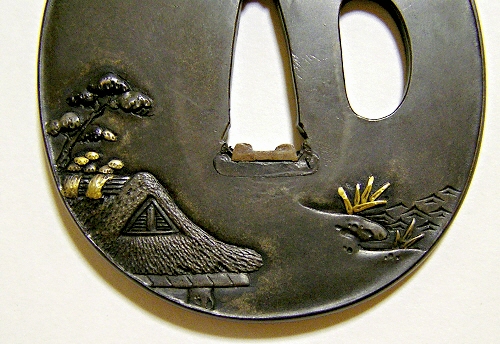
Shibuichi Migaki-Ji Tatemaru-Gata Iroe Zogan Takabori Tsuba
Reference Number |
TU-10162 |
|---|---|
Title |
[ Fisherman under the Moon ] |
Time |
The Edo period (1603 - 1868) |
Inscription |
" Yasuchika " |
L x W x H |
6.9 x 5.6 x 0.5 cm |
Nakago Hole |
2.2 x 0.7 cm |
Weight |
71 g |
Material |
Shibuichi (alloy of copper and silver) |
Box |
Wooden Box |
Certificate |
No Certificate |
Description |
You can know this tsuba was made with many techniques. |
Price |
Sold, thank you ! |


About Craftsman |
Yasuchika
Yasuchika (1670 - 1744) is very important craftsman in Japanese tsuba history. |
|---|
|
Features
|
|
|---|---|
 |
This tsuba is made of Shibuichi (alloy of copper and silver). This alloy metal is also called "Rogin" in Japanese because it emits faint moonlight. |
 |
The surfaces are polished well. |
 |
Its shape is oval. |
 |
Iroe technique is used for this tsuba. Iroe is very advanced metal brazing technique. |
 |
The motifs are expressed in high relief carving. |